B2B GTM Strategy 2026: Why Buyers Decide Before You Know They Exist
GROWTHFRACTIONAL CMO
3/17/20266 min read
61% of the B2B buying process is complete before a prospect ever contacts a vendor.
They have already researched. Already compared. Already asked ChatGPT and Perplexity to evaluate you against your competitors. By the time they fill out your form, you are not influencing a decision. You are confirming one.
And if your B2B GTM strategy is still built around forms, MQLs, and email sequences, you are losing deals you never knew existed.
The good news? This is fixable. Here is exactly what needs to change in 2026.
Are Your Buyers Using AI to Research You Without You Knowing?
Traditional search volumes are projected to fall 25% in 2026 as buyers switch to answer engines like ChatGPT, Perplexity, and Gemini for vendor evaluation.
This is not a future trend. It is happening right now.
When a buyer asks an AI assistant to compare GTM consulting firms or revenue operations tools, the AI synthesizes an answer from sources it trusts. If your content is not structured for AI comprehension, you are invisible in that answer. You are not on the shortlist. You never were.
Companies that proactively manage their AI visibility achieve up to 200x faster gains in share of AI voice compared to those that do not.
What does that mean practically for your B2B GTM strategy:
Publish structured, evidence-backed content that answer engines can cite
Earn mentions on third-party review platforms, communities, and authoritative sources
Use schema markup and clear question-based content structure
Treat generative engine optimization (GEO) the same way you once treated SEO
The dark funnel is not mysterious. It is just a stage of the unified revenue architecture that most GTM teams have no system to address. BriskFab's AI-powered revenue acceleration practice is built to fix this from the ground up.
Why Are Siloed GTM Teams Losing Deals in 2026?
Most B2B pipeline problems are not caused by bad products or weak teams.
They are caused by a GTM architecture built around internal department convenience rather than the AI-native buyer journey.
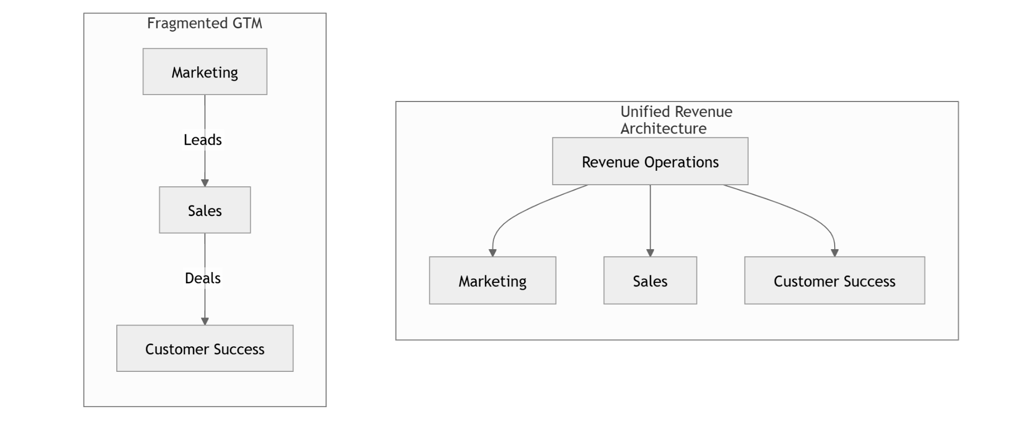
Marketing optimizes for MQLs. Sales optimizes for quota. Customer success optimizes for NPS. Each team is doing its job correctly inside a system that is collectively producing unpredictable revenue.
The data on this is impossible to ignore:
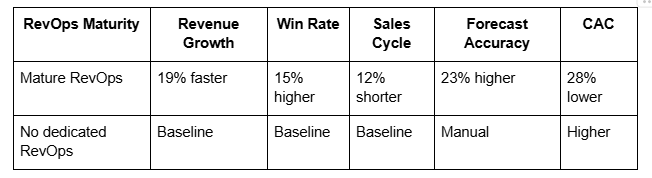
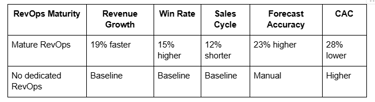
75% of high-growth B2B companies have now centralized their data, processes, and technology under a unified Revenue Operations function. Three years ago, that number was under 30%.
The shift is not coincidental. It is causal.
When AI gets deployed across a fragmented GTM motion, every broken handoff becomes visible. Agents break when there is no clear owner for a handoff. Lead scoring fails when marketing and sales use different definitions of a qualified lead. The dysfunction that once just slowed deals now causes visible system failures at scale.
Fixing this is not a technology decision. It is a B2B pipeline predictability decision. And it requires senior GTM leadership to own it. This is exactly the work BriskFab's Fractional CMO practice is built to lead.
How Do You Sell to a Buying Committee of 13?
When a prospect finally engages, they are not one person. They are a committee.
The typical B2B purchase in 2026 involves 13 internal stakeholders and 9 external participants. Your champion is not enough. Every objection raised in a stakeholder meeting you were not in is a deal risk you cannot see.
94% of buyers in committees of six or more say the larger group helps secure the budget and validate the decision. That means multi-stakeholder deals are not a problem to solve around. They are the reality to design for.
What the best GTM teams are doing differently:
Using AI deal scoring to track engagement signals across all stakeholders, not just the primary contact
Flagging stalled deals early based on sentiment and CRM activity before they go cold
Building content for each stakeholder role: the economic buyer, the technical evaluator, and the procurement team separately
If your sales motion is still built around a single champion, you are losing deals in rooms you were never in. Read how better products are still losing in 2026 and why the GTM motion is now the real differentiator.
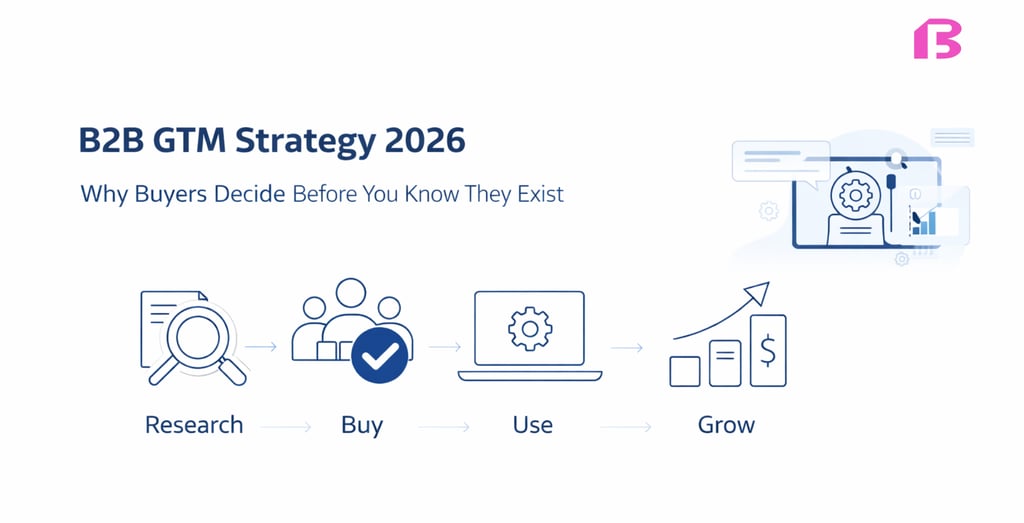
The 4 Stages of the AI-Native Buyer Journey
The modern B2B buyer does not follow a linear funnel. They move through four continuous stages. Most companies are strong in one or two and essentially invisible in the others.
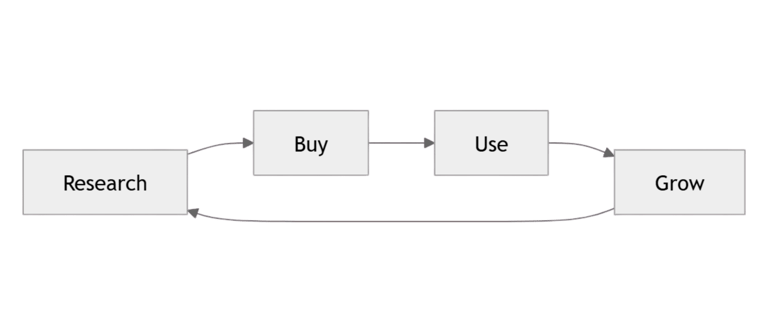
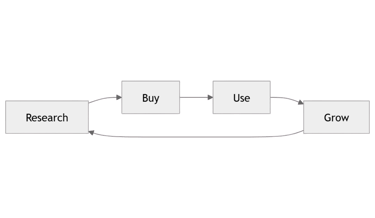
Stage 1: Research
Buyers use AI assistants to evaluate vendors before visiting any website. According to Forrester's 2026 buyer insights, 61% of the decision is made in this stage. If you are not showing up in AI-generated answers, you are not on the shortlist. Fix: invest in GEO, structured content, and third-party citations.
Stage 2: Buy
A committee of 13 or more is evaluating your solution. Fix: use deal intelligence to track engagement signals across all contacts, not just your champion.
Stage 3: Use
Retention is won or lost long before renewal conversations happen. Product telemetry carries 40% of the predictive weight in churn modeling. Fix: monitor usage signals and intervene 60 days before a customer is at risk, not after.
Stage 4: Grow
Expansion opportunities are predictable if you have the right signals. Fix: connect customer goals with commercial signals so your CS team identifies expansion months before contract renewal, not during it.
Most B2B companies at the $1M to $20M ARR stage are invisible at Stage 1, reactive at Stage 3, and scrambling at Stage 4. That is where revenue leaks. BriskFab builds the AI-powered revenue systems that close these gaps stage by stage.
What Companies That Rebuilt Their GTM Architecture Are Seeing
The results from companies that redesigned their unified revenue architecture around the AI-native buyer are not marginal.
OpenText unified 10 business units into a single intent-driven revenue engine and delivered 27% new marketing-influenced revenue within 30 days. Conversion rates lifted 600%. Meetings booked increased 51%.
Flexera went from contract signing to full GTM rollout in 12 weeks and saw an 82% pipeline lift from high-intent accounts within six weeks of launch.
Socure used signal-stacked intelligence to generate $52 million in new pipeline through a unified account health view.
These are not outliers. They are the result of one deliberate decision: stop building GTM around internal workflows and start building it around how AI-native buyers actually behave.
Here Is What You Should Do Right Now
If your B2B pipeline feels unpredictable right now, the issue is almost never the channel. It is the architecture underneath the channel.
Answer these three questions honestly:
1. Are you visible in AI-generated vendor evaluations?
If you do not know, you are probably not. Start with your content structure and third-party presence.
2. Are marketing, sales, and customer success operating on the same data?
If each team has its own definition of a qualified lead, no campaign will fix that. It is a structural problem that requires a structural solution.
3. Do you have a system to identify customers at risk before they tell you?
If your churn signal is a cancellation email, you are 60 days too late.
Fixing one of these changes your pipeline. Fixing all three changes your business.
Read how smart B2B companies are allocating their marketing budget in 2026 to understand where the highest-ROI investments are right now.
Talk to our senior marketing leadership about rebuilding your GTM architecture →
FAQ's
What is an AI-native GTM strategy?
It is a B2B revenue system designed around how AI-native buyers actually behave. Buyers today research through answer engines, buy in large committees, and expect contextual engagement at every stage. An AI-native GTM strategy connects data, intelligence, outreach, and revenue insights into one unified architecture that improves with every deal closed.Why are siloed GTM teams underperforming in 2026?
Because AI exposes every broken handoff. When marketing, sales, and customer success operate on different data and different metrics, gaps that once just slowed deals now cause visible failures in AI-powered workflows. Mature RevOps functions solve this and grow 19% faster as a result.How quickly can we see pipeline results?
Companies that fix their data foundation and deploy intent-based engagement workflows typically see measurable pipeline improvement within 30 to 60 days. The intelligence and retention layers compound over time as the system ingests more data from your pipeline.Is this only relevant for large B2B enterprises?
No. The $1M to $20M ARR stage is where getting the GTM architecture right creates the most competitive advantage. At this stage every leaked deal and every invisible buyer interaction has an outsized impact on growth trajectory.