Buyer Enablement vs Sales Enablement: Why Most SaaS Teams Optimize the Wrong One
GROWTHSAAS
12/23/20255 min read
Most SaaS teams believe stalled deals are a sales problem.
The instinctive response is predictable: improve pitch decks, refine talk tracks, roll out better battlecards, and run more sales training. In other words, double down on sales enablement.
Yet buying cycles keep getting longer. Deals stall after strong demos. Champions go quiet. Consensus breaks down late in the process.
What if the real bottleneck is not how well sellers sell, but how hard it is for buyers to buy?
In a world where B2B buying is increasingly self-directed and consensus-driven, many SaaS teams are optimizing the wrong side of the equation. They are investing heavily in sales enablement while under-investing in buyer enablement. And that mismatch is quietly killing deal velocity.
Sales enablement vs buyer enablement: a critical distinction
Before getting opinionated, let’s get precise.
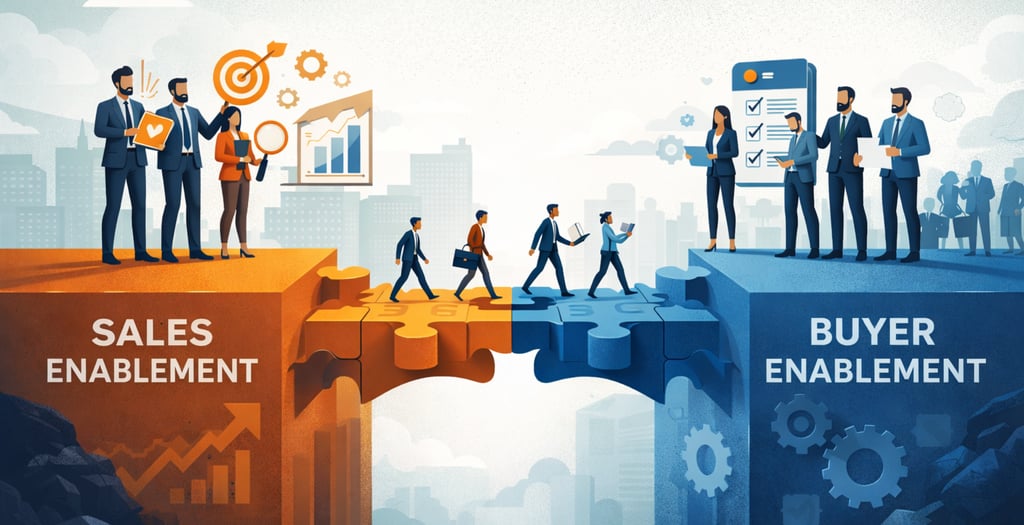
Sales enablement focuses on equipping sellers with the content, training, and tools they need to sell more effectively. This includes pitch decks, demo scripts, objection handling, CRM workflows, and coaching programs. The goal is to improve seller performance and consistency.
Buyer enablement, on the other hand, focuses on helping buyers complete critical buying tasks faster and with less friction. These tasks include diagnosing the problem, evaluating options, aligning stakeholders, building a business case, and justifying the final decision internally.
A simple way to frame the difference:
Sales enablement optimizes the seller’s ability to run the process
Buyer enablement optimizes the buyer’s ability to complete the decision
Both matter. But they solve very different problems.
Why this matters now more than ever
The shift toward buyer enablement is not theoretical. It is driven by real, structural changes in how B2B buying works today.
Buyers want fewer sales interactions
Gartner research shows that a majority of B2B buyers now prefer a rep-free or low-rep buying experience. Buyers want to move at their own pace, explore options independently, and involve sales only when necessary.
This alone should challenge the assumption that improving seller performance is the primary growth lever.
At BriskFab, we see this play out repeatedly: strong interest, strong demos, but stalled momentum because buyers lack the tools to move internally once sales step back.
Buyers spend very little time with vendors
On average, buyers spend only a small fraction of their total buying time interacting with suppliers. The majority of the work happens internally, in meetings you never see and discussions you never influence directly.
That internal work is where deals slow down or fall apart.
Self-serve is no longer just for small deals
High-value B2B purchases are increasingly happening through remote and self-serve models. Buyers are willing to make six- and even seven-figure decisions without traditional, rep-led processes.
This means the buying experience itself has become part of the product. If it is confusing, risky, or hard to justify internally, buyers hesitate or walk away.
The real work of buying is not persuasion
One of the biggest mistakes SaaS teams make is assuming that buying is primarily about persuasion.
In reality, buying is about completing a set of jobs.
Modern B2B buyers move through non-linear “buying jobs” such as:
Identifying and agreeing on the problem
Exploring possible solutions
Defining requirements and constraints
Selecting and justifying a supplier
These jobs are revisited repeatedly and often in parallel. Progress is rarely clean or linear.
The hardest job of all is consensus.
Buying committees are large, diverse, and misaligned. Different stakeholders care about cost, risk, security, implementation effort, and outcomes. Even when everyone likes your product, agreeing on a course of action is difficult.
This is where many deals stall.
Sales enablement helps reps persuade during conversations. Buyer enablement helps champions persuade internally when you are not in the room.
What buyer enablement actually looks like in practice
Buyer enablement is often misunderstood as “more content.” That is the wrong mental model.
Buyer enablement is about tools that help buyers do their work.
These tools reduce uncertainty, clarify trade-offs, and make internal alignment easier. They are designed to move buying jobs forward, not just explain features.
Here are common buyer enablement assets mapped to real buying jobs:
Problem identification
Diagnostic assessments
Benchmark and maturity reports
Cost-of-inaction calculators
Solution exploration
Interactive product demos
Scenario simulators
“How this works in your environment” walkthroughs
Requirements building
Security and compliance documentation
Implementation plans and timelines
Stakeholder-specific summaries
Supplier selection
ROI and business case builders
Competitive comparison frameworks
Procurement-ready summaries
A simple test helps separate real buyer enablement from marketing collateral:
Does this asset help a buyer complete a specific buying task faster or with more confidence?
If the answer is no, it may still be good content, but it is not buyer enablement.
This is often where BriskFab works with SaaS teams – not to create more assets, but to identify where buyer friction actually exists and design enablement around those moments.
Why most SaaS teams still over-invest in sales enablement
If buyer enablement is so important, why do so many teams under-invest in it?
There are a few common reasons.
First, sales enablement has a clear owner, budget, and mandate. Buyer friction is harder to see and harder to assign responsibility for.
Second, teams naturally optimize what they can control. Sellers are internal. Buyers are external. It feels safer to improve internal performance than to redesign the buying experience.
Third, short-term pipeline pressure pushes teams toward tactics that show immediate activity, even if they do not reduce decision friction.
The result is a system optimized for conversations, not decisions.
A better optimization model: buyer progress first
The goal is not to abandon sales enablement. It is to rebalance priorities.
High-performing SaaS teams start by optimizing buyer progress, then layer sales enablement on top.
This requires a shift in how success is measured.
Instead of focusing only on activity metrics like content usage or call volume, teams begin tracking signals of buyer progress:
Time to internal business case
Number of stakeholders engaged
Frequency of buying-stage regression
Decision latency between stages
Sales enablement supports conversations. Buyer enablement supports decisions. When buyer progress improves, sales efficiency improves as a byproduct.
Conclusion: the question SaaS leaders should be asking
Sales enablement makes sellers better at selling.
Buyer enablement makes buying easier.
In a world where buyers do most of the work alone, optimizing the seller while ignoring the buyer creates friction where it matters most.
If your deals are stalling after good demos and genuine interest, the problem may not be your sales team.
The better question to ask is this:
Are you enabling your reps, or are you enabling your buyers to actually decide?
FAQ’s
1. What is buyer enablement in SaaS?
Buyer enablement is not about giving buyers more content. It’s about helping them do the hard work of buying. That includes diagnosing the problem, aligning stakeholders, and justifying the decision internally. In modern SaaS buying, where most decisions happen without sales in the room, buyer enablement reduces friction where deals actually stall.
2. How is buyer enablement different from sales enablement?
Sales enablement makes sellers better at running conversations. Buyer enablement makes buyers better at making decisions. Sales enablement focuses on pitch quality and rep performance. Buyer enablement focuses on internal alignment, confidence, and momentum inside the buying group. Both matter, but they solve very different problems.
3. Why is buyer enablement becoming more important now?
Because buying no longer happens on sales calls. Buyers move independently, revisit decisions, and build consensus internally long before a deal closes. When SaaS teams optimize only for sales interactions, they leave buyers unsupported during the moments that matter most. Buyer enablement fills that gap.
4. What actually counts as buyer enablement content?
If it doesn’t help a buyer move a decision forward, it’s not buyer enablement. Real buyer enablement looks like diagnostics, ROI models, comparison frameworks, security documentation, and implementation plans. These tools help buyers reduce risk, explain trade-offs, and get internal approval, not just understand features.
5. Can buyer enablement really shorten SaaS sales cycles?
Yes, but not by pushing buyers harder. Buyer enablement shortens sales cycles by removing internal friction. When buyers can build consensus and justify decisions on their own, deals move faster without more pressure from sales. Sales efficiency improves as a result, not as the starting point.