
How to Do Content Planning for B2B SaaS Companies in 2026 - a Practical, Revenue-Focused Playbook
SAASGROWTH
12/18/20255 min read


Content is still the best scalable way to attract attention, reduce sales friction, and shorten acquisition cycles. But in 2026, content planning cannot be a publishing checklist. It must be a business discipline that ties directly to acquisition, activation, and retention.
This blog gives you a concise, tactical plan you can implement this quarter - audit first, decide where to concentrate, build content as a system, distribute deliberately, and measure outcomes that matter.
1. Diagnose first, publish later
Stop guessing. Start with a short, focused audit.
Key questions to answer in week one:
Who is the buying committee, and what are their top three problems?
Which competitor domains actually own attention in search and why?
How strong is your SEO baseline - domain rating, backlink profile, and organic traffic patterns?
Domain strength matters. It determines whether you can win with breadth or must win with precision. Use the audit to choose a conservative path if your domain strength is low, or a broader approach if it is high.
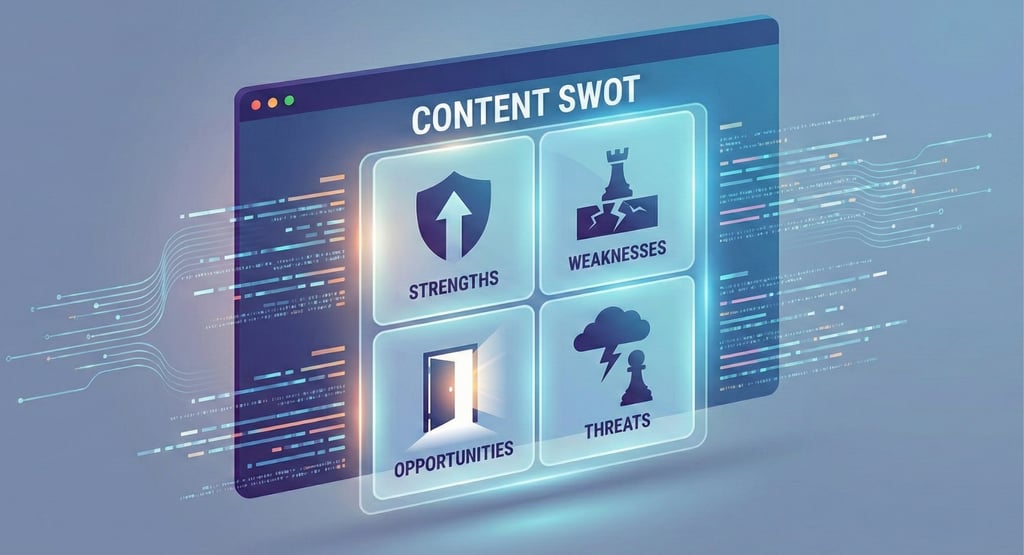
Actionable deliverable: a one-page Content SWOT that lists 3 strengths, 3 weaknesses, 3 opportunities, and 3 threats based on data, not opinions.
If you want a second set of eyes on your audit or SWOT, this is often where Briskfab helps teams pressure-test assumptions before committing to a content roadmap.
2. Move from volume to intent
Traffic is not the goal. Revenue is. Classify keywords and topics by intent:
Awareness: problems and trends
Consideration: approaches and comparisons
Decision: case studies, ROI, integrations
Prioritize content that maps to buyer intent closest to purchase. High-intent content usually drives fewer visits but materially better leads and conversion rates. This is where the founder and sales teams will notice measurable changes.
Practical tip: For each target persona, build a 3-piece bundle - 1 awareness piece, 1 consideration piece, and 1 decision piece - and design a conversion path from the decision piece to the product demo or trial.
3. Build content as a system, not a batch of posts
Think pillar pages, cluster articles, and deliberate internal linking. Structure matters more in 2026 because discovery is increasingly mediated by AI and structured answers.
A pillar page should:
Explain a core problem in 1,500–3,000 words
Link to 5–8 cluster posts that answer specific buyer questions
Link to product pages and one gated asset for lead capture
Internal linking signals topical authority and helps buyers and search engines follow a coherent learning path. This is not SEO trickery; it is how you turn content into a persistent asset.
4. Use data to choose where to invest - and how much
Establish a content growth model. Tomasz Tunguz style: quantify tradeoffs.
Example model:
If domain rating > 60, allocate 60 percent of effort to pillar/awareness and 40 percent to conversion content.
If domain rating < 30, allocate 70 percent to high-intent, narrow topics that can rank with depth and original insight.
Add a lightweight KPI dashboard:
Content-influenced leads
MQL to SQL conversion rate for content leads
Time to first meaningful visit after publishing
Backlinks and referring domains earned
Numbers will guide editorial choices. Metrics turn opinion into decisions.
If you are unsure how to build a content growth model that aligns with your revenue targets, this is another area where a short working session can save weeks of experimentation.
→ Talk to a content strategist
5. Make content sales useful - not just readable
Hiten Shah asks: does this content help close deals faster?
For each core page, add:
A one-line commercial takeaway for sales
A short FAQ that handles common objections
A downloadable example or mini case study the rep can forward
Sales usage is an outcome. Track whether your sales team is using assets and whether those assets shorten demo cycles or increase win rates. This is how content becomes revenue engineering.


6. Invest in craft - clarity converts
Ann Handley’s principle is simple: clarity is conversion.
Write for humans:
Use short paragraphs and clear headings
Use examples and analogies that a buyer understands
Be opinionated where it helps choices, not ambiguous
One strong headline, one clear promise in the first 60 words, and an action step at the end - those matter more than cleverness.
If you want a quick editing rule, read each page aloud. If any sentence trips you, fix it.
7. Don’t treat retention as an afterthought
Elena Verna’s lifecycle focus matters more as MRR grows. Content is a retention tool as much as an acquisition channel.
Add post-sale content to your roadmap:
Onboarding guides that increase activation
Feature use cases that drive stickiness
Expansion plays that teach advanced workflows
Measure whether content reduces time to value and improves NPS or usage metrics. Retention content compounds like marketing compound interest.
8. Use AI to accelerate, not replace
AI helps with research, outlines, and repurposing. Do not use it to generate hollow content.
Use AI for:
Drafting structured outlines
Generating research summaries, you must verify
Converting long posts into email sequences, scripts, and slides
Always add human insight, unique data, or customer voice on top of any AI output.
9. Quick execution checklist (30-day sprint)
Week 1: Audit - Domain rating, backlinks, top 20 pages, competitor overlap. Produce Content SWOT.
Week 2: Select 3 priority themes based on intent, impact, and competition.
Week 3: Produce 1 pillar + 3 cluster posts. Include sales one-pager and gated asset.
Week 4: Distribute - SEO checks, LinkedIn narrative, email to list, and targeted paid amplification for the pillar.
Ongoing: Weekly measurement and adjustments.
Final thought: treat content planning like product planning
Content is not creative noise. It is a product. Ship minimum viable content that teaches, converts, and retains. Iterate using data. Build systems that scale. If your content can shorten a sales cycle by even 10 percent, you will see that impact on CAC and ARR. That is how content becomes a strategic moat.
→ Book an intro call to see how your current content stack performs against this framework.
FAQ
1. How should B2B SaaS companies plan content in 2026?
B2B SaaS companies should plan content in 2026 by starting with an audit, mapping topics to buyer intent, and aligning content with acquisition, sales conversion, and retention goals. Content planning should be treated as a revenue strategy, not an editorial calendar.
2. What is the most effective content strategy for B2B SaaS?
The most effective B2B SaaS content strategy focuses on high-intent content that supports the buyer journey, including problem education, solution comparison, and decision-stage proof. Fewer, deeper assets tied to revenue outperform high-volume publishing
3. How does content planning impact SaaS revenue growth?
Content planning impacts SaaS revenue by improving lead quality, shortening sales cycles, and supporting customer retention. When content answers real buyer questions, it reduces friction in both acquisition and expansion
4. How much content should a B2B SaaS company publish?
A B2B SaaS company should publish based on domain strength and buyer intent, not a fixed schedule. Low-authority sites perform better with fewer, high-intent pieces, while high-authority sites can scale broader content without losing efficiency.
5. How do you measure B2B SaaS content marketing success?
B2B SaaS content marketing success should be measured using business metrics such as content-influenced pipeline, MQL-to-SQL conversion rate, sales usage of content, and retention impact, not just traffic or rankings.