
How to Improve MQL to SQL Conversion in 2026 (Without Generating More Leads)
GROWTH
3/19/20267 min read
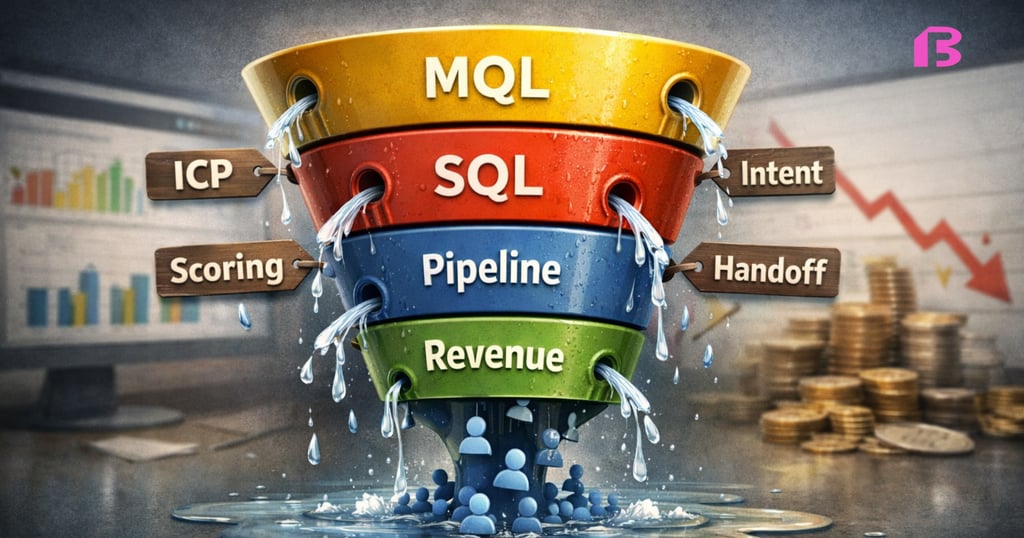
We hit our MQL targets every single month. But sales keeps telling us the leads are garbage.
Sound familiar? Your dashboard is green, MQL count is up, marketing is celebrating, and then the VP of Sales says 80% of those leads are a waste of time. Wrong company size. No budget. Someone who downloaded an ebook at midnight with zero intent to buy.
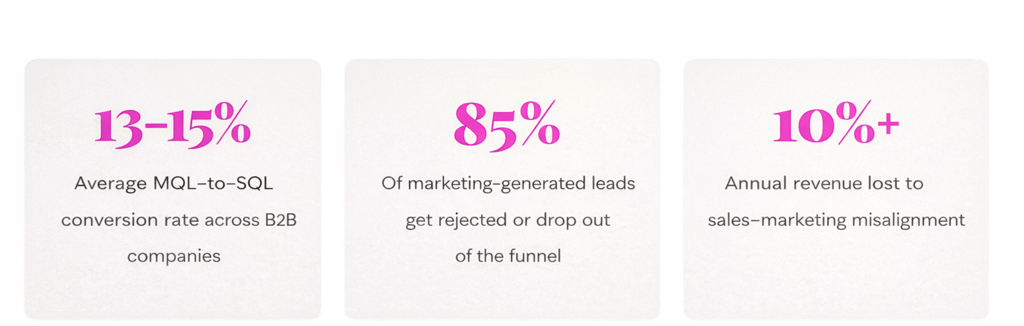
That 85% rejection rate isn't a sales problem. It's a structural go-to-market problem, and it quietly destroys CAC, wastes your best sales reps' hours, and creates a cultural rift between two teams that should be working as one revenue function.
This guide gives you the benchmarks, the diagnostics, and the 12-tactic playbook to get there. It's built for VPs of Marketing and RevOps leaders who are ready to move from lead volume to lead quality.
What Is MQL-to-SQL Conversion And Why Does It Matter?
Before benchmarks and tactics, let's define what we're actually measuring — because mismatched definitions between marketing and sales are often the root cause of the whole problem.
The Definitions
Marketing Qualified Lead (MQL): A lead that meets marketing's criteria for sales readiness based on demographic fit (company size, industry, job title) and behavioral engagement (content downloads, website visits, email opens). An MQL is marketing saying: "This person is worth sales' time."
Sales Qualified Lead (SQL): A lead that sales has evaluated and accepted as a legitimate opportunity - typically validated against Budget, Authority, Need, and Timeline (BANT). An SQL is saying: "Yes, we'll work this."
The gap between those two statements is where lead quality debates live, and revenue dies.
The Formula
MQL-to-SQL Rate = (SQLs ÷ MQLs) × 100
Example: 15 SQLs from 100 MQLs = 15% conversion rate
What This Metric Tells You
Lead quality, not just lead quantity. 500 MQLs at 5% conversion is worse than 150 MQLs at 30% conversion by almost every metric that matters.
Sales-marketing alignment. Low conversion almost always means misalignment on ICP, scoring criteria, or definitions. High conversion means both teams are calibrated to the same buyer.
CAC and pipeline efficiency. Moving from 12% to 25% conversion effectively doubles your sales capacity without a single new hire.
MQL-to-SQL Diagnostic Audit
Identify exactly why your conversion is low - with channel analysis, rejection tracking, and scoring audit worksheets.
MQL-to-SQL Benchmarks: What "Good" Actually Looks Like
Most companies are stuck at average and calling it acceptable. Here's the full picture.
Overall B2B Benchmarks (2026)
Below 10% - Red flag. Serious misalignment between marketing and sales on ICP, or your lead scoring model is fundamentally broken
10% to 15% - Average. You are hitting benchmarks but leaving a significant pipeline on the table
20% to 25% - Solid. Good alignment and a decent scoring model
30% to 40% - Excellent. Top-performer territory with tight ICP definitions and intent-based qualification
Above 40% - Either exceptional, or you are scoring too conservatively and leaving volume behind
The Funnel Drop-Off: Where Leads Actually Die
The 85% rejection number is a summary. Let's look at where exactly things break down across the funnel.
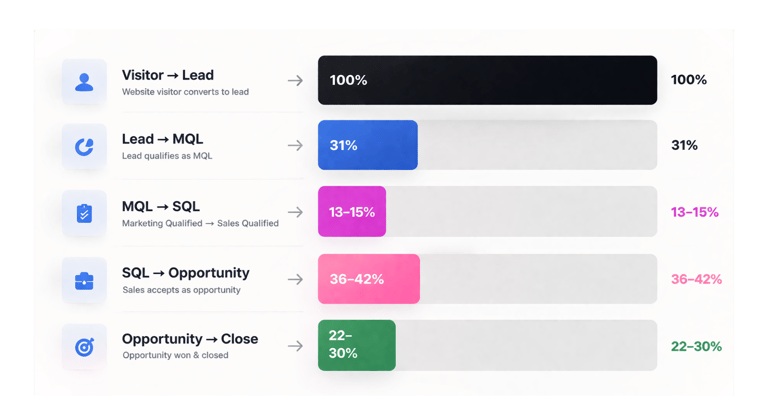
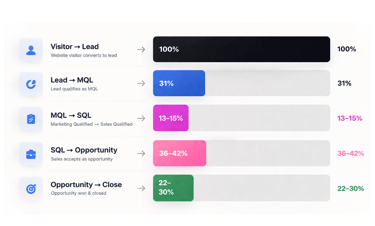
Source: Data-Mania, Prospeo, Visora - 2025/2026 benchmarks
The largest single drop is the MQL-to-SQL gate. Everything before it and after it converts at reasonable rates. It's the handoff that breaks. And it breaks for predictable, fixable reasons.
Why Your MQL-to-SQL Rate Is Low: The 7 Root Causes
After auditing conversion funnels across dozens of B2B companies, we've identified seven root causes that account for nearly all low-conversion situations. Find yours — then skip to the matching tactic.
ROOT CAUSE 01
Misaligned ICP Definitions
Marketing targets companies with 10 to 50 employees because the volume looks good. Sales rejects them because deals under 100 employees never hit revenue targets. Neither team is wrong. They are just not talking.
The fix: Quarterly ICP alignment sessions where marketing and sales review won deals, lost deals, and rejected leads together. Update targeting based on what actually closes, not what generates form fills.
ROOT CAUSE 02
Activity-Based Scoring Over Intent
A junior employee doing competitive research scores the same as a VP evaluating vendors - because both downloaded your ebook. Static point systems reward passive behaviors like email opens and webinar registrations. These are not buying signals. They are research signals.
The fix: Add intent signals to your scoring. Pricing page visits, competitor comparison activity, repeat sessions from multiple stakeholders in the same week - these are real buying signals. A blog post view is not. Our AI-powered revenue acceleration practice rebuilds these scoring models from scratch for B2B SaaS teams.
ROOT CAUSE 03
Lead-Level Thinking in a Committee-Based World
The average B2B deal now involves 10 to 14 stakeholders. Optimizing for a single MQL means you are ignoring the CFO, IT evaluator, and procurement team who are quietly making the actual decision. Your champion is not enough.
The fix: Shift from lead-level to account-level qualification. When an IT manager downloads a technical spec and a CFO visits your pricing page in the same week, that is one account in an active buying cycle - not two separate leads.
ROOT CAUSE 04
Volume-Based KPIs
Marketing is incentivized on lead count. Sales is incentivized on the close rate. These two metrics are structurally opposed. When marketing dumps leads to hit their monthly quota, sales waste up to 60% of their time on accounts that will never buy.
The fix: Measure marketing on pipeline created and revenue influenced - not leads generated. When marketing is paid on the same outcome as sales, the volume-at-any-cost culture disappears almost immediately.
ROOT CAUSE 05
No Shared MQL/SQL Definition
Sales rejects leads but doesn't tell marketing why. Marketing doesn't see which leads actually close. Neither team has the data to improve. Marketing keeps generating the same bad leads. Sales keeps complaining. Nothing changes.
The data decays monthly - up to 22% in some industries - making follow-up efforts increasingly futile without a live feedback mechanism.
ROOT CAUSE 06
Speed-to-Lead Problems
Responding to a lead within 5 minutes makes you 9× more likely to qualify it than waiting 30 minutes. Most B2B sales teams take 24–48 hours or longer. By the time sales connects, the lead has moved on, forgotten filling out your form, or already talked to a competitor.
ROOT CAUSE 07
Wrong Channel Strategy
If 60% of your MQLs come from Meta at a 6% conversion rate, your overall conversion will always be terrible - regardless of how good your scoring model is. Channel mix is an upstream problem that no amount of downstream optimization can fully compensate for.
Not sure which root cause is yours?
Briskfab offers a free 45-minute GTM audit to diagnose your specific conversion bottleneck.
What Should Replace or Upgrade the MQL in 2026?
Three frameworks are outperforming the traditional MQL model right now.
Product Qualified Leads (PQLs)
For companies with a free trial or freemium model, this is the gold standard.
A PQL is not someone who has read about your product. It is someone who used your product and reached a meaningful activation milestone, demonstrating they have already experienced value.
→ PQLs convert at 8x the rate of MQLs
→ Conversion rates of 25% to 30% versus roughly 2% for content-based MQLs
→ Atlassian receives nearly 500 demo-qualified leads per week through product-led motions that convert 6x higher than traditional MQLs
If your product has a trial and you are not tracking PQL activation milestones, you are leaving your best buying signal completely untracked.
Account Qualified Leads (AQLs)
This shifts the frame entirely. Instead of tracking what one person did, you track what an entire account is doing.
→ When an IT manager downloads a technical spec and a CFO visits pricing in the same week, that is an account surge - one unified buying signal
→ 6sense processes over one trillion buyer signals daily to surface exactly these patterns
→ FullStory used this approach and saw a 48% increase in Average Contract Value and 36% increase in marketing-influenced pipeline in a single quarter
You do not need a trillion signals. You need the right signals at the account level.
Sales Qualified Opportunities (SQOs)
The SQO moves the qualification gate further down the funnel. An SQO is a deal formally accepted by an Account Executive after personally verifying fit, urgency, budget signal, and a clear next step.
→ SQOs close at 15% to 30% compared to just 6% for general SQLs
→ Less volume. Dramatically better pipeline predictability
→ HubSpot formalized this with their Lead Object, creating dedicated pipeline stages for qualification - reducing handoff delays and cleaning up the sales workspace significantly
The Bottom Line: Quality Over Volume, Always
85% MQL rejection is normal. But normal is not acceptable when it's burning your sales team's capacity, inflating your CAC, and creating a culture where marketing and sales fundamentally distrust each other.
The companies that break out of 13–15% conversion don't do it by generating more leads. They do it by generating better ones. That requires three things working together:
Alignment - a shared ICP definition, shared MQL/SQL criteria, and a formal SLA that both teams own
Intent-based scoring - a model that weighs buying signals over engagement signals, BANT over behavior alone
Continuous improvement - monthly rejection reason reviews, quarterly ICP sessions, closed-loop attribution that tells you what's actually working
Start with the SLA. Everything else follows from alignment. And if you want help diagnosing exactly where your funnel is breaking, Briskfab offers a free 45-minute GTM audit for B2B marketing and RevOps leaders.
FAQ's
What is a good MQL to SQL conversion rate for B2B SaaS?
Top-performing B2B SaaS companies with enterprise ICPs hit 30% to 40%. The overall B2B average is 13% to 15%. If you are at or below average, tightening ICP alignment and adding intent-based scoring typically moves the needle within 60 to 90 days.Why do sales reject so many MQLs?
The three most common reasons are: wrong company size or industry (ICP mismatch), no real buying intent (research behavior mistaken for purchase intent), and no buying authority (a junior contact who cannot make the decision). All three are fixable through better scoring and aligned definitions.Should we get rid of MQLs entirely?
Not necessarily. The label is not the problem. The scoring model behind it is. If your MQL definition includes intent signals, buying group engagement, and timing indicators alongside behavioral engagement, it can still work. Most MQL models only track the behavioral layer. That is the problem.How does BriskFab help with MQL to SQL conversion?
Through our AI-powered revenue acceleration practice, we rebuild the qualification infrastructure: intent-based scoring, buying group tracking, automated qualification workflows, and aligned GTM metrics. Our Fractional CRO practice owns the strategic alignment between marketing and sales end to end - including the ICP definition, the SLA, and the feedback loop that keeps both teams honest.